

Welcome to The S-Curve
Now you will be able to receive the latest announcements, product updates, and our insights on the mortgage market in real time.
The name of the blog, the S-Curve, is a reflection of our logo and the central feature of our prepayment model. S-curves are seen in nature in many phenomenon, from population growth to prepayment and default models. Our first S-curve, in the early 1990s, used the arctangent function, then piece-wise linear functions, and evolved over time to be more complex and vary by FICO, loan size and LTV. This evolution encapsulates both the timeless nature of fundamental relationships and constant innovation to describe them better over time.
We hope you find the information useful and we look forward to your feedback.
-
 Andrew Davidson Shared His Perspective on UBS Expert CallEvents
Andrew Davidson shared his perspective on credit score modernization and the outlook for mortgage prepayments in a recent conversation with Marissa Lobo, a mortgage REIT analyst with UBS.
The talk was titled "Beyond FICO: Vantage Scores, Borrower Behavior and Market Implications with Andrew Davidson" and held on Tuesday, September 29, 2026 from 11:00AM – 12:00PM ET.
Here is a summary of the conversation*
*Source: Beyond FICO: Vantage Scores, Borrower Behavior and Market Implications with Andrew Davidson © UBS 2026 All rights reserved. Reproduced with permission.
This excerpt has been adapted from a UBS research report for publication on this site. Certain UBS analyst-authored commentary and opinions have been removed. The omitted material was not part of the expert speaker’s remarks. This excerpt therefore does not represent the research report in its entirety.
-
 White Paper: A Purpose-Driven Approach to Model ValidationThoughts
Financial institutions rely on models for a wide range of purposes, including valuation, forecasting, risk management, capital planning, accounting, trading, and reporting. The same model may be used differently by different organizations, and sometimes differently within the same organization. For that reason, model validation should not begin with the question, “Is the model correct?” Instead, the more useful question is: “Is the model appropriate for the purpose for which it is being used?”
Read Now
-
 Intern Corner: Are Two Scores Better Than One?Thoughts
Over the past summer, Andrew Davidson & Co., Inc. (AD&Co) was pleased to have Stephanie Duenas and Anika Chatterjee interning with us at our office in New York City. During this time, Stephanie and Anika performed a detailed analysis of mortgage performance data to consider the question of whether and how two credit scores, when available, could provide lift over a single score in predicting mortgage delinquencies. Given Bill Pulte’s recent announcement that all securitized products issued by the GSEs will include both a FICO score and a VantageScore, their research is especially timely and relevant.
Stephanie and Anika’s full paper describes their approach and compares the performance of several credit-score based models in detail. It should be noted that the usual caveats, due to historical GSE qualification based on Classic FICO, apply here, especially when looking at the performance of individual score models; minor differences are unlikely to be meaningful. However, the primary outcome of this research is that the use of both scores, when available, can provide significant lift over the use of any single score. More detailed extensions of this analysis are ongoing, for example: (i) How do other potential combinations of scores compare with those analyzed here; (ii) How can AD&Co’s credit models, which also account for variables such as LTV and DTI, make the most effective use of multiple scores; and (iii) How does the analysis change when using FICO 10T instead of Classic FICO. Meanwhile, find Stephanie and Anika’s paper linked below.
This paper will be a valuable resource for your work. If you have any questions or would like to discuss the content in more detail, please contact support@ad-co.com.
-
 2026 Cultural and Volunteer DayEvents
AD&Co in Action: Volunteer & Cultural Days 2026
At Andrew Davidson & Co., Inc. (AD&Co), our values extend beyond the work we do for our clients. Humanity, inclusivity, dedication, citizenship, creativity, and integrity shape how we engage with one another and with our community. This August, members of the AD&Co team took the opportunity to put those values into practice during our Volunteer Day supporting Volunteers of America-Greater New York’s Operation Backpack® and our Cultural Day at Ellis Island.
Operation Backpack®
For AD&Co’s Volunteer Day, employees participated in Operation Backpack®, Volunteers of America-Greater New York’s annual community service initiative supporting children living in New York City shelters. Operation Backpack provides unhoused K-12 students with new backpacks and school supplies, helping ensure they can begin the school year equipped with everything they need to be successful.
For the third year in a row, our team spent the morning filling backpacks with school supplies that would ultimately make their way into the hands of these local students.

We invite you to click the link for more information on Volunteers of America-Greater New York’s Operation Backpack®.
Ellis Island
For our Cultural Day, AD&Co employees took the ferry over to Ellis Island to participate in the Save Ellis Island’s Hard Hat Tour, an in-depth, off-the-path guided tour of Ellis Island’s Hospital Complex and grounds, visiting areas that were closed to the public for more than 60 years. The complex included a hospital that once cared for immigrants who arrived at Ellis Island with illnesses or medical conditions. Approximately 1.2 million immigrants were treated there over the course of its history.
Also, throughout the complex, we had the chance to see Unframed—Ellis Island, an installation by French artist JR. The site-specific works bring immigrant stories to life through historic photographs incorporated directly into the abandoned spaces. Save Ellis Island works in partnership with the National Park Service to preserve and restore these historic buildings so that this chapter of American history remains accessible to future generations.
Walking around the island gave our team a unique perspective on the history of immigration in New York City and the country as a whole and highlighted the human experiences that form an important part of American history. In the same vein, AD&Co’s culture is defined by a series of ethical and personal values that define who we are and how we operate. By recognizing our multi-cultural workforce, it allows us to operate with a wider expanse of ideas and viewpoints in our day-to-day work. Ellis Island provided a meaningful setting for reflection.
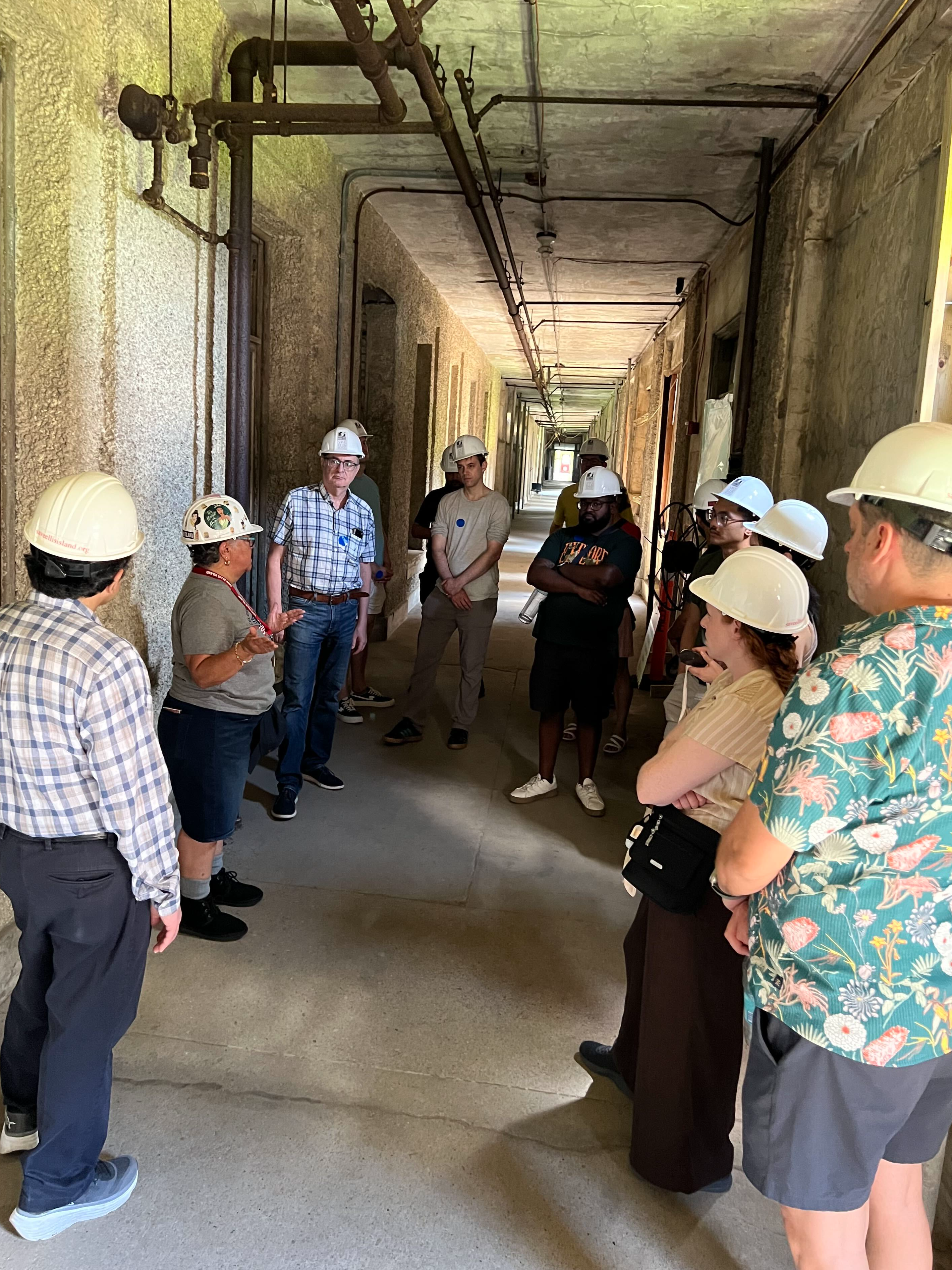
For more information on the Save Ellis Island organization or their Hard Hat Tour, please visit their website.
Values
Both of these fantastic experiences reinforce AD&Co’s commitment to fostering a culture in which different perspectives are valued, people are treated with respect, and our responsibilities extend beyond the walls of our offices.
We are grateful to Save Ellis Island and Volunteers of America-Greater New York for giving our team the opportunity to take a step back from our day-to-day responsibilities to give back to and educate ourselves about our community.
We look forward to continuing to find ways to learn, participate, and give back together.
-
 Now Available: AD&Co’s Quantitative PerspectivesThoughts
Recently, aggregators have crossed market borders by issuing residential mortgage-backed securities (RMBS) backed by owner-occupied (OO), GSE-eligible conforming loans. Additionally, conforming mortgage loans have drawn investment interest from insurance companies fronted by aggregators and evaluated by third-party firms. These developments constitute historically rare disintermediations of the nearly monopsonist purchases of conforming loans by the GSEs.
We're thrilled to announce our latest Quantitative Perspectives where Mickey Storms and Alex Levin present examples of how Andrew Davidson & Co., Inc. (AD&Co) financial engineering techologies can be used by loan sellers and originators to fully evaluate the economics of GSE-conforming loan pricing, GSE credit fees, and loan sale options. Click below to read the full paper.
This paper will be a valuable resource for your work. A login is required for access. If you have any questions or would like to discuss the content in more detail, please contact support@ad-co.com.
The S-Curve Archives
-
 Events
The Data Foundation of Mortgage Finance
Homeownership is the largest source of wealth accumulation and inter-generational wealth transfer for the working and middle class. However, the non-interest cost of financing is always an obstacle for first-time and low-wealth buyers, and underserved populations.
-
 Thoughts
In this blog post, we used the recently updated Mortgage Market Statistical Annual to examine the dynamics of residential loan origination by state and by market segments and highlight important trends.
-
 Products
Andrew Davidson & Co., Inc. (AD&Co) is pleased to announce the official release of Kinetics v1.10, the latest update to AD&Co’s modular platform for running the AD&Co suite of analytics. This update introduces the Multifamily LoanDynamics Module, the newest way to run Multifamily LoanDynamics Model (LDM). Investors, servicers, insurers and lenders can leverage this new module to better understand the prepayment and credit risk of their multifamily mortgage portfolio.
-
 Events
Andrew Davidson & Co., Inc. (AD&Co) held a webinar on June 8th entitled “Lessons Learned: Insights for Managing the Interest Rate Risk of Banks.” Mickey Storms from our Alliances and Policies team, Alex Levin from our Financial Engineering team and Andrew Davidson were featured speakers.
-
 Products
Andrew Davidson & Co., Inc (AD&Co) is pleased to announce the beta release of a new monthly report series titled “Specified Pool Prepayment Trends,” which aims at showing market prepayment trends for specified agency pools in support of pay-up analyses by investors, traders, and alike.
-
 Products
Andrew Davidson & Co., Inc (AD&Co) is pleased to announce that Polypaths LLC supports AD&Co’s Auto LoanDynamics Model (Auto LDM) providing prepayments, defaults and losses on auto loans and securities.
-
 Events
The Structured Finance Association hosted SFVegas 2023 (February 26 - March 1), a broad capital markets conference with thousands of attendees in Las Vegas. Andrew Davidson & Co. Inc. (AD&Co) was a sponsor focused on the mortgage sector. As we engaged with clients and policy leaders, a few themes emerged: Data, Expanding Access Safely, Ginnie Mae Servicing and Auto Loan Performance.
-
 Products
Andrew Davidson & Co., Inc (AD&Co) is pleased to announce the official release of the LoanDynamics Module in Kinetics, AD&Co's new modular platform for running AD&Co analytics via a desktop application, web browser, or REST API. The LoanDynamics Module is the latest way to run the LoanDynamics Model, allowing users to perform sensitivity analysis, validation testing, and scenario analysis in a modern, user-friendly application.
-
 Thoughts
Recently the Federal Housing Finance Agency (FHFA) announced some upcoming changes related to the use of new credit scores, FICO 10T and VantageScore 4.0 by Fannie Mae and Freddie Mac. “FHFA expects that implementation of FICO 10T and VantageScore 4.0 will be a multiyear effort. Once implemented, lenders will be required to deliver both FICO 10T and VantageScore 4.0 credit scores with each loan sold to the Enterprises”.[1] This announcement will impact the entire mortgage ecosystem.
-
 Thoughts
January is National Mentoring Month which is very appropriate since it coincides with the time when we typically set out our goals and intentions for the New Year. Organizations are embracing mentoring programs and these programs have indeed become a strategic imperative for many. There are many benefits to mentorship and it's easy enough to comprehend. The individuals involved in a mentoring relationship and the organizations that choose to sponsor a mentoring program all are likely to benefit.